 Jupiter Walkies guide

Short answer
A 30-minute dog walk burns roughly 90–220 calories for most adults, depending on body weight and pace. Heavier walkers and brisker paces sit at the top of that range.
In this guide6 sections · 3 min
Roughly 90 to 220 calories per 30 minutes. The spread is wide because two things dominate: how much you weigh, and how fast you are actually moving.
Where the number comes from
Calorie estimates for walking are built on METs — metabolic equivalents, a measure of how hard an activity is relative to sitting still. One MET is resting. Walking at 2 mph is about 2.8 METs; a steady 3 mph is about 3.5; a brisk 3.5 mph is about 4.3.
The standard conversion is:
So a 73 kg adult walking briskly: 4.3 × 3.5 × 73 ÷ 200 = 5.5 calories a minute, or about 165 over half an hour.
Knowing the formula matters because it tells you which levers actually move the number. Weight and pace are in the equation. Breed of dog, lead length and how much you enjoyed it are not.
Rough numbers by weight and pace
| Body weight | Strolling (2 mph) | Steady (3 mph) | Brisk (3.5 mph) |
|---|---|---|---|
| 130 lb / 59 kg | ~85 cal | ~110 cal | ~135 cal |
| 160 lb / 73 kg | ~105 cal | ~135 cal | ~165 cal |
| 190 lb / 86 kg | ~125 cal | ~160 cal | ~195 cal |
| 220 lb / 100 kg | ~145 cal | ~185 cal | ~225 cal |
These are 30-minute figures at a constant pace. Halve them for fifteen minutes, double for an hour. Hills, soft ground and carrying things push them higher.
What changes the number most
- Hills. The single biggest multiplier available to you. Walking uphill can roughly double the MET value, so a hilly route at an easy pace beats a flat route at a brisk one.
- Terrain. Soft sand, mud or snow raise the cost of a walk substantially over flat pavement at the same pace.
- Carrying. A backpack, or a small dog on the way home, adds load and therefore cost.
- Pace consistency. Stopping every thirty seconds to sniff lowers the average considerably — which is why a tracked figure is usually below a calculator estimate.
What it means for weight
Worth being honest about the arithmetic. Two brisk half-hour walks a day is around 300 calories for an average adult. Over a week that is roughly 2,100 — somewhere near a third of a kilogram of fat, if nothing else changes.
That last clause is where it usually falls apart, because appetite tends to rise to meet activity. Walking is genuinely useful for weight management, but as a floor of daily movement that persists for years, not as a lever you can pull against an unchanged diet. If the goal is weight loss, the walking is the easy half — the intake side is where it is usually won or lost.
How it compares
For perspective, 30 minutes of brisk dog walking sits in roughly the same range as 30 minutes of gentle cycling or a slow swim, and well below running. The advantage is not intensity — it is that it happens every single day, twice, regardless of motivation, which almost no other form of exercise manages.
Two 30-minute dog walks a day is around an hour of daily movement that would otherwise not happen. Consistency beats intensity for that kind of baseline activity.
Getting a more accurate number
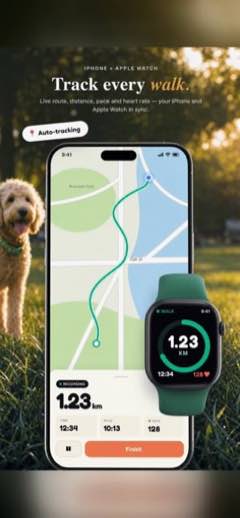
- Track the walk with GPS rather than estimating minutes — actual distance and moving pace matter more than elapsed time.
- Log your weight, since it is the largest single variable in the formula.
- Do not add your dog’s activity to yours. They are having a very different workout, and a much shorter-legged one.
- Treat every figure as an estimate with real error bars. Individual metabolism varies, and no wrist device measures calories directly.